


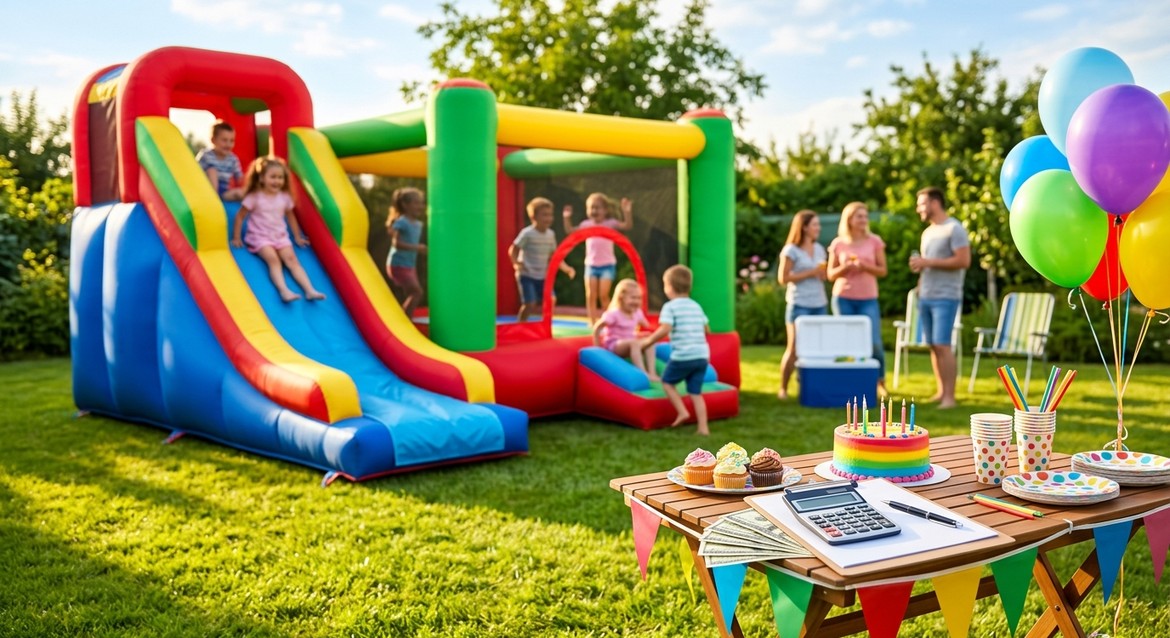
Here’s the short version, right up top: in 2026, a bounce house party usually costs somewhere between $150 and $600 once you add delivery and setup, with most families landing near $250 to $400 for a standard backyard rental. Book an indoor package instead and you’re often looking at $300 to $700 for a group of 10 to 15 kids, depending on the day and the extras. This bounce house party cost guide breaks down every line item so the final cost doesn’t surprise you.
Who is this for? Parents planning a birthday, teachers organizing school events, and anyone in the Shreveport area trying to build a realistic budget before they call around. Why does it matter? Because a rental quote can look simple and then grow by a hundred dollars once travel fees, a generator, or an overnight add-on gets tacked on. Knowing what drives bounce house rental prices up or down puts you back in control. Let’s walk through it together.
If you just want a quick answer, here it is. Renting a bounce house typically costs between $100 and $500 for a standard 4-to-8-hour rental, according to pricing summaries from EJ Fun Day and Jumper House. A basic unit usually runs $100 to $300 for 4 to 6 hours, as noted by Reventals, while a standard bounce house rental lands around $225 to $400 for a full 8 hours per the parent’s guide from Big Wave.
That base price is only part of your total cost. Extras like delivery outside the standard delivery area, a generator when there’s no power on site, overnight hold time, and a tip for the crew all move the number. Most standard rental quotes cover 4 to 6 hours of use, so if your event planning calls for a longer day, expect to pay for extra hours. Bounce house rental prices vary based on size, features, and duration, and this guide covers each of those cost factors in turn.
Before you price anything, decide which kind of celebration you’re planning. There are two main paths, and they cost differently.
The first is a backyard bounce house rental. A local company drops off a unit or two, sets it up on your grass, and picks it up later that day. You supply the space, the food, the cake, and the supervision. This is the cheaper route if you already have a flat yard and decent weather, and it’s the classic choice for a kids birthday at home.
The second is an indoor package at a dedicated facility. You reserve a private room, the venue handles setup and safety, and a staffer runs the show while you enjoy the event. Packages usually price per child and bundle in tables, chairs, paper goods, and sometimes pizza and drinks. It costs more than a bare rental, but the weather never cancels your event and there’s no cleanup in your driveway. For rainy-day activities and busy family calendars, a lot of Shreveport parents decide the extra cost is worth it. Think about your party rental needs first, then see which path matches them.
Not every inflatable rents for the same price. The type of unit you choose is the single biggest lever on your cost, so here’s how the common categories compare.
A standard bounce house is the plain open-bounce unit most people picture: four walls, a mesh roof, a small step-in entrance. Basic bounce houses typically range from $100 to $300 for a 4-to-6-hour block, and a standard bounce house rental runs about $225 to $400 for 8 hours, per Reventals and Big Wave’s parent guide. That price usually includes delivery, setup, takedown, and cleaning within the local delivery area. For a small backyard birthday, a single standard unit is often all the equipment you need. A simple backyard party rental like this is the most common booking of the year.
Combo bounce houses add a slide, basketball hoop, and climbing area inside or attached to the bounce space. Combo bouncers include slides and interactive features, which is why families love them and why they cost more. Combo units rental prices generally range from $250 to $480, according to Party Crashers. Larger combo bouncers usually cost more than standard bounce houses because they use more material, weigh more, and take longer to set up. If your guest list skews older or you want one unit that keeps everyone busy for hours, a combo is the sweet spot.
A water slide is the summer favorite in Louisiana, and water slides are typically a higher-cost rental category due to their size and the extra setup care they need. Water slide rentals can cost between $250 and $500, per EJ Fun Day. Bigger dual-lane slides and tropical-themed units sit at the top of that range. Remember that a water slide needs a hose hookup, a wet spot to land, and a place where runoff won’t flood a neighbor’s yard.
Inflatable obstacle courses are the showstopper for large events, school field days, and church functions. Obstacle courses typically range from $300 to $600 or more, according to Party Crashers, and the long 40-plus-foot units can run higher. Specialty bounce houses, including themed courses and giant slides, can cost up to $800 per day, per Fun Times. These units also need the most space, so measure before you book.
The base rate is the sticker price. These extras are what turn a $250 quote into a $400 bill, so read your agreement closely and ask about every one of them.
Deliveries are often included within a local radius of about 15 to 20 miles of the warehouse, per an operator discussion summarized by Tent and Table. Go outside that delivery area and extra travel fees can range from $50 to $150. If you live on the edge of the metro or you’re hosting at a camp or park outside town, ask where the free-drop-off line falls before you fall in love with a unit.
Rental duration affects pricing, and overnight rentals typically add $50 to $100 to the base rate, according to pricing notes compiled by Hippo Rents and All Fun Bouncing Inflatables. Since most standard quotes cover 4 to 6 hours of use, a celebration that starts at noon and runs into the evening may push you into an extended-hours charge. If you want the unit set up early so the party starts on time, confirm whether that setup window counts against your hours.
Every inflatable runs on a blower, and most inflatables require a standard 110-volt outlet within about 100 feet of the setup spot. A standard 110-volt electrical outlet is needed for operation, as Orbit Moonwalks notes. No electrical outlet nearby? Generators may be rented for an additional cost of $50 to $100, per Wexford Insurance. Park and pavilion celebrations almost always need a generator, so budget for it.
Grass is the easy, cheap surface. Setup costs may increase if the inflatable is set up on difficult terrain or indoors, and setup on hard surfaces such as concrete or asphalt may incur additional fees for weights or tarps, since the crew can’t drive stakes and has to anchor with heavy sandbags instead. A slope, tree roots, or a tight side yard also takes longer and can carry a small charge. Tell the company exactly what your setup area looks like when you book.
Tipping the crew is customary and usually ranges from $20 to $50, per Tent and Table. The crew hauls a 200-plus-pound rolled inflatable, sets it, sanitizes it, and comes back to break it down. A tip isn’t required, but it’s a kind gesture for hot, heavy work, and most companies let you add it to the card or hand cash at drop-off.
Hosting at a Shreveport city park or a school? Rental companies often require, and the venue almost always demands, a certificate of insurance naming the park or district as additionally insured. Reputable operators carry this coverage and will file the paperwork, sometimes for a small fee. Ask early, because a park permit plus a certificate can take a week or two to process. Wexford Insurance covers this in its pricing breakdown for operators.
Bounce house rental prices vary based on size, features, and duration, but a few other cost factors matter just as much when you’re comparing quotes.
Size and capacity. Larger inflatables and larger units cost more to buy, transport, and staff, and that flows straight to your price. A 13-by-13 unit for toddlers rents cheaper than a 20-foot combo built for a dozen big kids at once.
Features. Slides, climbing walls, obstacle lanes, water hookups, and themed art all add cost. A plain bouncer is the value pick; every add-on feature nudges the price up.
Duration. Four hours is the base. Six, eight, or overnight all cost more. Ask what a standard block includes before you assume you get the unit all day.
Season and day of week. Peak season runs spring through early fall, and the busy seasons around Shreveport also include the mild weeks of late winter. Saturdays in April and October book out first and rarely get discounted. A weekday date, or one in the slower summer heat or mid-winter, is where you’ll find the best deal.
Geography. Rates differ by metro. Prices in a big coastal city often top what you’ll pay in the Ark-La-Tex, so national averages are a guide, not a quote. Always price locally.
Parents sometimes ask why they can’t just buy an inflatable at a big-box store for $300 and skip the rental. The answer is that store-bought and rental units are built for completely different jobs.
Consumer-grade inflatables are designed for occasional backyard use by a couple of children at a time. They use lighter fabric, simpler stitching, and smaller blowers. Consumer inflatables should not be used for commercial rentals, and most rental companies won’t touch them.
Commercial inflatables are a different animal. Commercial bounce houses are built with stronger materials and reinforced seams, with reinforced stress points at the corners and anchor loops that take real abuse. Commercial-grade inflatables are designed for repeated setup and use by larger groups, day after day, season after season. Commercial bounce houses cost between $1,000 and $3,000 each to purchase, according to Tent and Table’s cost analysis, and premium commercial inflatables run higher, a few thousand dollars apiece.
When you rent, you’re paying for that commercial equipment plus delivery, sanitizing, regular maintenance, liability coverage, storage, and trained staff. A rental business spreads the cost of its equipment across hundreds of bookings. That’s the real math behind the price, and it’s why a professional inflatable rental is safer than a driveway hand-me-down. It also explains why running a rental business is more expensive than the sticker price of a single unit suggests.
How many kids are coming? Guest count drives which unit you need and how much food and seating you’ll buy. Here’s how a backyard budget tends to shape up at different sizes.
Around 10 kids. One standard bounce house at $225 to $300, plus roughly $75 to $150 for pizza, drinks, cake, and paper goods. Total: about $300 to $475. A single unit handles this group with easy rotation.
Around 15 kids. A combo bounce house at $275 to $450 gives you a slide and climbing area so the line keeps moving, plus $150 to $250 for food and supplies. Total: roughly $425 to $700. This is the most common kids birthday size in Shreveport.
Around 20 to 25 kids. Either a large combo unit or two smaller inflatables, running $450 to $800 in equipment, plus $250 to $400 for catering-style food and extra seating. Total: about $700 to $1,200. At this size, two units keep wait times down and spread guests across the yard.
30-plus guests, school field days, or community events. Now you’re in obstacle-course and multi-unit territory, often $600 to $1,500 in inflatables alone before food, tables, and staff. For large events, an all-in indoor package or a venue with several inflatables under one roof is usually the better value and the lower headache.
Bounce houses should match the age group of the kids using them, and the right inflatable depends on who’s actually bouncing. Matching the unit to the crowd also keeps your spending sensible across age groups.
Toddlers and preschoolers. Younger kids prefer smaller, low-profile bounce houses with a low step-in, soft walls, and no steep slide. These regular bounce houses rent at the low end, roughly $150 to $275, and they’re the safe, right equipment for a 3-year-old.
Elementary kids, ages 5 to 12. This is the combo sweet spot: a bounce area, a slide, a hoop, and climbing areas to keep energy burning. Budget $275 to $475 for the unit. A bounce house with slide is the single most requested pick in this range.
Teens and school events. Bigger kids want obstacle courses, tall slides, and interactive games, plus more activities to spread a group out. Expect $350 to $700 per unit, and consider two units so 20 teens aren’t standing in one line.
Adults, corporate, and community events. Yes, grown-ups bounce too. Adult-rated units, jousting pedestals, and giant slides for company picnics and large events run $400 to $900-plus. Confirm the weight rating and per-user limits when adults are on the guest list.
A backyard rental wins on raw price when the stars align: flat yard, a nearby outlet, mild weather, and a parent willing to run the day. Skip any one of those and the math shifts.
Booking indoors folds the unit, the space, the setup, the safety monitoring, the tables, and the cleanup into one per-child price. There’s no weather risk, no generator, no travel surcharge, and no wet grass. For a 15-child event, an indoor package and a loaded backyard combo rental often land within a hundred dollars of each other once you total the backyard extras. The indoor option just moves the work off your plate.
The Bounce House Shreveport is built for exactly this. As Louisiana’s largest indoor inflatable fun park, it runs birthdays and group events with a huge variety of inflatables, dedicated party rooms, and a clean, climate-controlled space, so an August celebration is as comfortable as an October one.
You don’t have to overspend to give everyone a great day. A few smart moves can trim your cost without cutting the fun, and they’re the reason to save money without anyone noticing.
Book off-peak. A Friday or Sunday, a weekday in summer, or a date outside the spring and fall busy seasons often unlocks a lower rate or a free upgrade. Ask directly whether the company discounts slower days.
Book early. Locking in six to eight weeks out gets you the unit you want at today’s price and avoids the last-minute scramble that leads to travel fees for whatever’s still available.
Bundle, don’t à la carte. An all-inclusive indoor package or a rental bundle usually beats paying separately for a unit, tables, chairs, and add-ons.
Bring your own extras. Supply your own cake, decorations, goodie bags, and paper goods rather than paying venue markup, and skip cleaning supplies you won’t need because the crew sanitizes the unit for you.
Share the cost. Joint birthdays for two kids split one rental two ways. For school events, a PTA or neighborhood group can share a single obstacle course.
Right-size the unit. Don’t rent an $800 obstacle course for eight 5-year-olds. One unit, well chosen, is plenty, and the savings buy a better cake.
Price matters, but safety is what you’re really buying. A responsible rental company will provide setup and safety checks as part of the deal, not as an upsell, and that’s how it should ensure safety for every booking.
Bounce houses need flat, open ground for safety, and setup requires clearance around all sides, usually at least three to four feet, plus overhead room clear of branches and power lines. The crew stakes into grass or anchors with sandbags on hard surfaces, checks the blower and seams, and walks you through the rules before they leave. Proper setup like this is non-negotiable, and inflatables require it every single time.
Weather is the hard limit. Bounce houses should not be used in inclement weather, and operators will not run a unit in windy conditions above roughly 15 to 20 mph. Sudden Louisiana thunderstorms are exactly why you want a backup plan: an indoor space, a covered pavilion, or a rain date. Ask about the weather and cancellation policy before you pay a deposit.
For bigger celebrations, a trained attendant is worth every dollar. Bounce houses can require a trained attendant for safety during events to enforce capacity limits, keep big and little kids separated, and stop the roughhousing before someone gets hurt. Many venues include an attendant automatically; with a backyard rental, ask whether staffing is available and what it adds. Industry safety standards for these units are set out in ASTM F2374, and the U.S. Consumer Product Safety Commission publishes guidance on safe inflatable use.
Picking the right bounce house is part budget, part logistics. Start with the space you have.
Measure your yard before booking a bounce house. Note the gate width the crew has to roll a unit through, the flattest stretch of grass, and where the nearest outlet is. Share those measurements with the company and let them tell you which units fit; a good operator would rather right-size you than squeeze in a unit that doesn’t belong.
Then match the unit to the age groups on your list. A single low bouncer for toddlers, a combo with a slide and climbing walls for elementary kids, an obstacle course or tall slide for teens. If your guest list spans a wide age range, a combo with separate zones, or two units, keeps everyone safe and happy. When in doubt, describe your party rental needs to the company and ask for their recommendation, since they place these units every weekend and know what works. For more help comparing units, plenty of operators publish helpful guides on their sites.
Good event planning removes the stress. Here’s a simple planning schedule that keeps your event on track and on budget, so the day starts without a hitch.
Six to eight weeks out: set the date and the budget, get two or three local quotes, and confirm what each rental includes for delivery, hours, and setup.
Four weeks out: book the unit with a deposit, reserve any park permit and coverage certificate, and send invitations so you have a real headcount.
One to two weeks out: confirm the drop-off window, the setup spot, and the outlet or generator plan, and buy food, cake, and decorations.
Event day: clear the yard, unlock the gate, keep pets inside, have your tip ready for the crew, and station an adult or attendant at the unit the whole time.
Most families spend $250 to $400 on a standard backyard rental including delivery and setup, and $300 to $700 on an indoor package for 10 to 15 kids. Add food, cake, and decorations and a typical all-in bounce house party cost lands between $350 and $900.
Renting a bounce house typically costs between $100 and $500 for a standard 4-to-8-hour rental. A basic unit is $100 to $300 for 4 to 6 hours; a standard bounce house rental is about $225 to $400 for 8 hours; combos run $250 to $480; water slides $250 to $500; and obstacle courses $300 to $600 or more.
You’re not just renting fabric. Commercial bounce houses cost $1,000 to $3,000 each, and the price also covers delivery, professional setup, sanitizing, regular maintenance, liability coverage, storage, and staff. A rental business spreads that equipment cost across many bookings, which is what sets the rate.
Tipping the crew is customary and usually ranges from $20 to $50, depending on unit size, distance, and how tricky the setup is. It’s a courtesy, not a requirement, but it’s appreciated for heavy outdoor work.
Only if there’s no electrical outlet nearby. Most inflatables require a standard 110-volt outlet within about 100 feet. If your setup spot is a park or open field, plan on a generator, which most companies rent for an extra $50 to $100.
A standard unit needs roughly a 15-by-15-foot footprint plus three to four feet of clearance on every side and clear space overhead. Larger inflatables, combo bouncers, and obstacle courses need much more, so measure your setup area and confirm the fit before you book.
A bare backyard rental is cheaper on paper. Once you add travel outside the delivery area, a generator, extra hours, and your own food and setup work, an indoor package for the same group often costs about the same, with none of the weather risk or cleanup.
Six to eight weeks for a spring or fall Saturday, since those peak season dates sell out first. In the slower summer heat or mid-winter you can often book two to three weeks out, and you’re more likely to land a better price.
Bounce houses can’t run in inclement weather or windy conditions, so ask about the rain policy before you pay. Many companies offer a rain-date reschedule or a credit. Having a backup plan, an indoor room or covered pavilion, keeps the celebration alive.
It depends on the unit and the kids’ sizes, but a typical residential bounce house is rated for six to eight children of similar age at a time. The tag on the unit lists the limit; an attendant enforcing it is the best safety tool you have. Ask yourself how many will really be bouncing at peak before you pick a size.
A bounce house party doesn’t have to break your budget, and it definitely shouldn’t surprise you at drop-off. Start with the base rental for the unit type you need, add the realistic extras for delivery, power, hours, and a tip, and you’ll have a number you can actually plan around. Whether you rent for the backyard or book a room, this bounce house party cost guide should have you negotiating from a position of knowing exactly what you’re paying for. Those are the final thoughts worth carrying into your first phone call.
Want the easiest version of all of this? Skip the generator, the weather worry, and the driveway cleanup and let us host. The Bounce House Shreveport is Louisiana’s largest indoor inflatable fun park, with a massive variety of inflatables, dedicated party rooms, and a safe, clean space for kids and adults alike. It’s children’s entertainment without the setup stress, and there are always more activities than one afternoon can cover. Bring the cake; we’ll bring the bounce. Check party packages and open dates at The Bounce House Shreveport and let’s make your celebration bounce.