


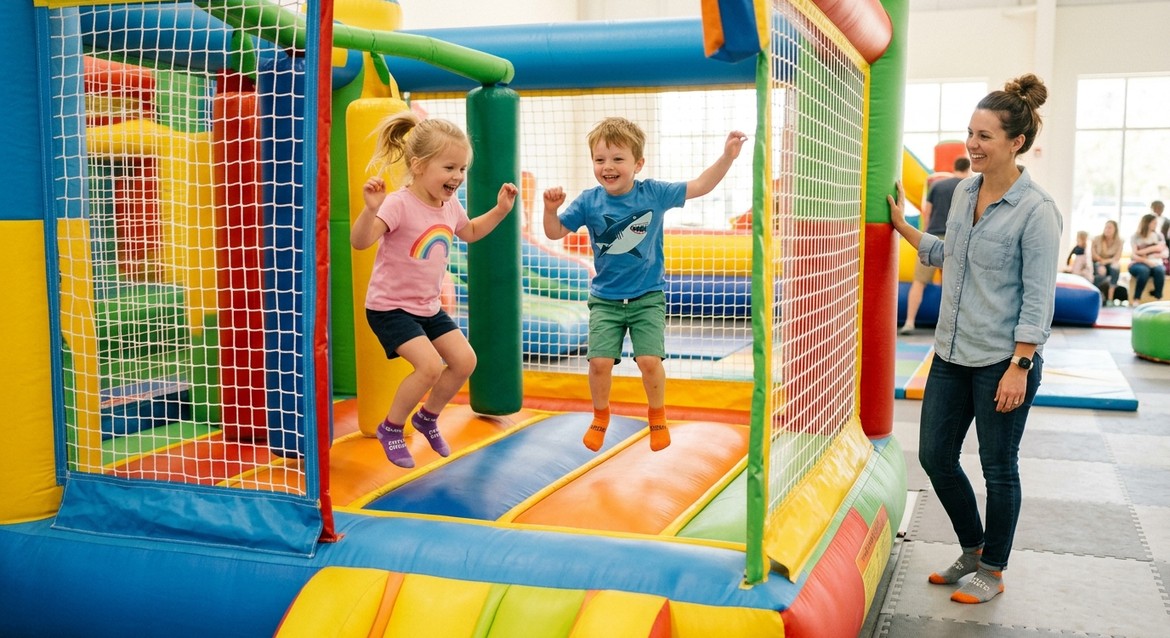
Picture the scene. It’s your kid’s birthday, the inflatable castle is humming away, and a dozen sugar-fueled children are piling in at once. Somewhere between the cake and the goody bags, a little voice in your head asks: are bounce houses safe, really? It’s a fair question, and the honest answer is “yes, mostly,” as long as the adults in charge know the handful of rules that separate a great day from a trip to urgent care.
This guide walks through what the research actually says about bounce house injuries, why they happen, and the simple bounce house safety habits that keep children safe. We’ll also cover toddlers, backyard rentals, weather, and how indoor parks handle safety differently. Got a party coming up? Keep reading. Bounce house injuries are more common than most parents think, but they’re also some of the easiest to prevent injuries around.
Can most children bounce safely on a regular basis? Yes, with a big asterisk. Inflatable play structures are soft, forgiving, and a whole lot of fun, but they’re still active play equipment. Children are jumping, landing, and bumping into each other in a space that moves under their feet. That’s where the risk comes from. Every extra child in the bouncer means the risk of injury increases, too.
The good news is that most accidents aren’t random. They follow clear patterns, like too many children at once, big kids jumping with little ones, risky stunts, and nobody watching. Fix those, and you’ve removed most of the danger. Think of it like a swimming pool: nobody says pools are safe or unsafe, they say pools are safe with the right supervision and rules. Bounce houses work the same way.
Let’s look at the data, because it helps to know what you’re actually dealing with. A study published in the journal Pediatrics estimated that 64,657 children were treated in U.S. hospital emergency departments for inflatable bouncer injuries between 1990 and 2010. Even more eye-opening, those injuries rose about 15-fold from 1995 to 2010. By 2010, around 31 children a day were being treated, which works out to roughly one child every 46 minutes.
The trend didn’t slow down, either. Researchers cited by CHOC Children’s found that 82,748 children were injured from 2015 to 2019, compared to 5,599 from 2000 to 2004. And the U.S. Consumer Product Safety Commission estimated more than 18,000 ER-treated injuries tied to bounce houses in 2018 alone. So yes, tens of thousands of emergency room visits each year are linked to inflatable bouncers.
Before you panic, here’s the other side of the story. According to that same CHOC report, 96.4% of kids were treated and discharged from the ER. In other words, most injuries are the painful-but-fixable kind, not life-changing ones. Some part of the rise is also simple math, since far more bounce houses exist today than in 1995.
What do these injuries look like? In the Pediatrics study, broken bones (27.5%) and strains or sprains (27.3%) topped the list. So the most common injuries are fractures, sprains, and muscle strains, plus bruises and the occasional cut. About 1 in 5 injuries (19%) involved the head or neck, according to coverage of the Nationwide Children’s research. That’s why a concussion is a real, if less common, possibility. CHOC also found a concussion was almost twice as likely in children over 6 than in younger kids, probably because bigger kids jump higher and hit harder.
Falls were the number one cause in the Pediatrics data, accounting for about 43% of bounce house injuries. That includes falling inside the bouncer, falling out of it, and getting hurt while climbing in or out. Collisions are the other big one. When two kids of very different sizes collide mid-air, the smaller child usually takes the worst of it. Collisions tend to occur most often when the bouncer is crowded.
Most injuries occur when a few risk factors stack up at once: overcrowding, a lapse in supervision, rough play, and kids of different ages mixed together. Remove one or two of those, and the risk of injury drops. Remove all of them, and you’ve done most of the work of injury prevention.
Parents ask this a lot, so let’s tackle it. Bounce houses and trampolines both involve jumping, but they’re built differently. Trampolines have a firm, springy mat that can launch children surprisingly high, a metal frame, and springs around the edge. Bounce houses have soft walls and a cushioned floor that absorbs more of each landing.
That doesn’t mean one is automatically safe and the other isn’t. Home trampolines are a well-known source of broken bones, and the American Academy of Pediatrics has long discouraged backyard trampolines. Bounce houses share several of the same hazards, like multiple jumpers colliding and children attempting stunts. The main difference is that trampolines tend to produce higher, harder falls, while bounce houses are more likely to cause collisions and awkward landings.
Here’s the practical takeaway. The same habits that make trampolines less dangerous also work for bounce houses: one age group at a time, no somersaults, and an adult watching. If your children already know good trampoline manners, they’re halfway to good inflatable manners too.
These are the safety rules that make the biggest difference for bounce house safety. None of them are complicated, but enforcing rules consistently is what actually keeps kids safe and makes safe play the norm.
If you only remember one thing from this article, make it this: a responsible adult should be watching the entire time. Adult supervision helps prevent overcrowding, stops rough play before it escalates, and makes sure everyone behaves. Lapses in supervision come up again and again when children get hurt. Treat an inflatable like a pool or a playground: you wouldn’t leave little ones alone at either one, so don’t do it here.
Good supervision means actually watching, not scrolling your phone near the entrance. At commercial parks, a trained attendant usually handles this job, but parents still play a part. You know your child best, and you’ll spot when they’re getting tired or overexcited.
Mixing different ages is one of the biggest risk factors. A 10-year-old landing on a 4-year-old is a recipe for tears. The researchers behind the Pediatrics study suggested that when more than one child is bouncing, everyone should be about the same age and size. At home, that might mean taking turns: the little ones for ten minutes, then the older group.
Every inflatable comes with manufacturer guidelines for weight and capacity, usually printed on a label near the entrance. Follow those weight limits and occupancy limits every time. Overcrowding in bounce houses raises the chance of collisions, and too much load can strain seams and anchors. If the label says six jumpers, six means six, even if twelve are begging to get in.
Have children remove shoes, glasses (when possible), jewelry, hair clips, and anything in their pockets before they climb in. Sharp objects can scratch other jumpers or puncture the vinyl, and hard items become projectiles when a child jumps. Socks are the way to go, and grip socks are even better since they reduce slipping.
Flips and somersaults are how a lot of neck and head injuries start. The CPSC specifically recommends teaching children not to tumble, wrestle, or do flips. Rough play like pushing and tackling is another common cause of serious injury, especially when a heavier child lands on a lighter one, so set the tone early. A simple line works: “Bouncing only, no flips, hands to yourself.”
A surprising number of accidents happen at the exit points, when children tumble out headfirst or jump off the edge. Show children how to slide out feet first and never to jump out of the entrance. Keep the area right outside the exit clear, since those waiting their turn tend to crowd the doorway. Walls and netting are there to prevent children from falling out, but they only work if kids stay off them.
Toddlers love bounce houses, but they’re also the most vulnerable jumpers. They’re unsteady on their feet, they can’t always get out of the way, and they’re easy for bigger jumpers to knock over. In fact, researchers have noted that preschoolers are among the most frequently injured age groups.
Some pediatric researchers recommend restricting use to children 6 and older. That’s a cautious guideline, and plenty of families still let toddlers bounce. If you do, a few things help a lot:
At The Bounce House Shreveport, for example, our toddler area is designed for children under 4, so the littlest bouncers get their own space away from the big kids.
Renting or buying a backyard inflatable adds a few safety issues that indoor parks handle for you. Most of these come down to proper setup and paying attention to environmental factors like wind and surface conditions.
Set the bounce house up on flat, level ground cleared of rocks, sticks, and other debris. Use every anchor point and stake it down according to the manufacturer’s instructions. Keep it well away from tree branches, fences, and power lines. Proper inflation matters too: a blower that’s unplugged, overheated, or knocked loose can make the structure lose air fast, and a sagging structure is how kids end up tangled or crushed together. Keep children away from the blower and any gas generator, and never run cords through standing water.
Wind is the scariest hazard for backyard units. A gust can lift a poorly anchored bounce house off the ground with kids inside. According to the CPSC, maximum wind speed should be no more than 15 to 25 mph when you’re using a bounce house. Head injuries and falls can occur fast when a unit shifts or tips. When the weather looks questionable, go with the low end of that range and shut things down once the wind picks up past about 15 mph. Don’t use bounce houses during storms, either. Rain makes vinyl slippery, and lightning plus a big electric blower is a combination nobody needs.
In 2019, the CPSC also reported 12 deaths tied to bounce houses between 2003 and 2013, and several involved inflatables blown away by gusts. That’s rare, but it’s the reason weather conditions deserve real attention on party day.
Before anyone climbs in, walk around the inflatable. Look for tears, loose seams, missing stakes, and sharp objects on the floor. Check that the safety netting is intact, since a child can get trapped if they slip behind a loose net. If something looks off, fix it before anyone goes in. A torn seam can turn a minor bump into a serious injury. These quick checks are some of the simplest safety measures you can take.
Here’s where indoor inflatable parks shine. A well-run indoor facility removes a lot of the variables that cause backyard accidents. There’s no wind to lift anything into the air, no rain making the vinyl slick, and no wondering whether someone anchored the thing correctly.
Commercial inflatables also follow industry safety requirements. In the U.S., the ASTM F2374 standard covers the design, installation, operation, and inspection of commercial inflatable amusement devices. Add staff who enforce safety guidelines, age-appropriate zones, and posted rules, and you get a setup built for safe operation every day, not just on party day.
At our indoor playground, bouncers wear grip socks, a parent or guardian stays on site, and separate areas keep toddlers away from older kids. If you want a refresher before your visit, our guide to bounce house etiquette covers the house rules, and our post on what to wear helps you dress kids for the day.
Even with every precaution, children sometimes get hurt. Most bumps and bruises just need a hug and a short break. But watch for signs that something is more serious: a limb they won’t put weight on, swelling that keeps growing, or any head injury followed by vomiting, confusion, unusual sleepiness, or a headache that gets worse. Those call for a doctor right away.
After any hard fall, take your child out of the inflatable for a while, even if they insist they’re fine. Young jumpers are great at recovering emotionally, and not always great at noticing when they’re actually injured.
Here’s a quick checklist of injury prevention tips to run through before anyone starts jumping. A responsible adult watches the whole time. Children of the same age and size jump together. Weight limits and capacity rules are followed. Shoes, jewelry, and sharp objects stay outside. No tumbling or wrestling. Outdoors, the unit is anchored, the surface is flat, and the weather is calm. That’s it, and it doesn’t take long. Those few habits are what bounce house safety comes down to, and they’re how you prevent injuries without spoiling anyone’s fun. Good bounce house safety is really just good habits, repeated every time.
Researchers have suggested that parents consider limiting bounce houses to children 6 and older, with younger kids bouncing only under close supervision and away from bigger jumpers. Many families let toddlers bounce in a separate toddler area, which is a reasonable middle ground.
Follow the manufacturer’s occupancy limit, and if in doubt, go with fewer. The Pediatrics researchers went further and suggested one child at a time for the safest play. At the very least, keep groups small and similar in size.
Fractures, sprains, and muscle strains are the most common, followed by bruises and cuts. Head and neck injuries, including concussion, make up a smaller but important share.
Outdoor inflatables can if they aren’t anchored properly, especially in strong wind. That’s why the CPSC recommends staking them on flat ground and not using them when it’s too gusty. Indoor inflatables don’t have this problem.
They carry many of the same risks, but bounce houses tend to have softer landings. Either way, the best safety measures are the same: supervision, no stunts, and grouping jumpers by size.
What rules do you use at home? Every family has its own spin, and the best ones are the ones kids actually remember.
So, are bounce houses safe? With good supervision, sensible rules, and the right setup, they absolutely can be. And if you’d rather skip the anchoring and the weather worries, come see us. The Bounce House Shreveport is Louisiana’s largest indoor inflatable park, with a toddler area for little ones, obstacle courses and slides for bigger kids, and open bounce for adults too.
Planning a celebration? Our private party rooms make birthday parties easy, with grip socks included and staff on hand to help. Stop by for some weekend fun with open bounce, or book your party today and let the little ones jump while you relax.